

Chocolatey离线(offline)安装流程
创始人
2024-09-26 00:49:09
首先要确定你能下载什么版本的chocolatey,具体版本对照参考该网址:
Chocolatey Software Docs | Chocolatey Components Dependencies and Support Lifecycle
从这个网站可以找到安装和卸载的详细说明。
Chocolatey Software Docs | Setup / Install
详细步骤如下:
步骤 1:下载 Chocolatey 安装包
Chocolatey Software | Chocolatey 2.3.0
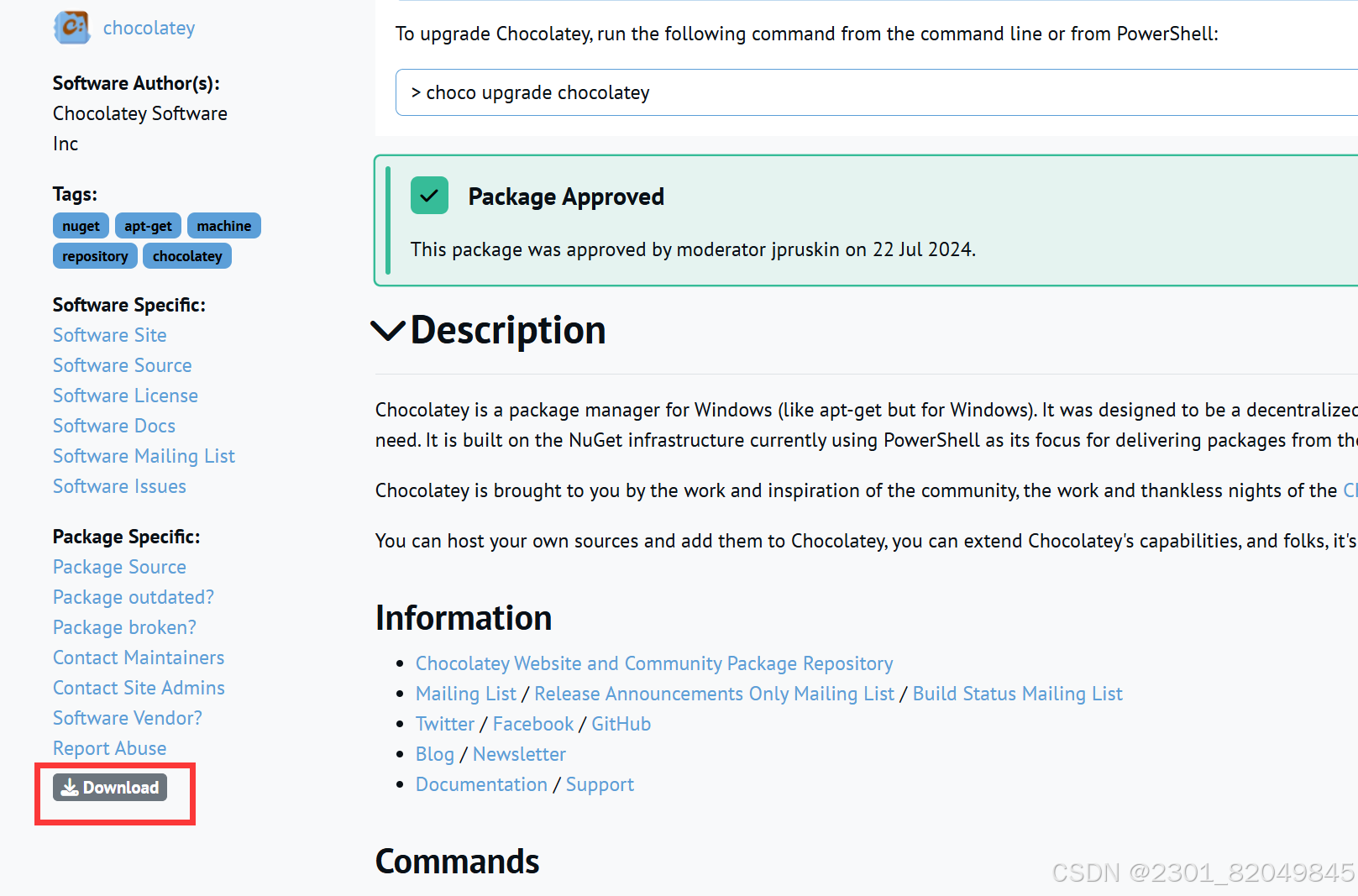
点击左下角的download下载你想要的副本,记住你的安装路径。
步骤2:转移文件位置
为了避免C盘爆满,将下载的 .nupkg 文件复制到离线机器上的某个目录。例如,将文件复制到 C:\offline-choco 目录。博主转移到了D:\user-unity3D\user-chocolatey。
步骤3:创建和运行安装脚本
①将你提供的脚本保存为一个.ps1文件,例如 install_choco_offline.ps1。
# Download and install Chocolatey nupkg from an OData (HTTP/HTTPS) url such as Artifactory, Nexus, ProGet (all of these are recommended for organizational use), or Chocolatey.Server (great for smaller organizations and POCs) # This is where you see the top level API - with xml to Packages - should look nearly the same as https://community.chocolatey.org/api/v2/ # If you are using Nexus, always add the trailing slash or it won't work # === EDIT HERE === $packageRepo = '' # If the above $packageRepo repository requires authentication, add the username and password here. Otherwise these leave these as empty strings. $repoUsername = '' # this must be empty is NOT using authentication $repoPassword = '' # this must be empty if NOT using authentication # Determine unzipping method # 7zip is the most compatible, but you need an internally hosted 7za.exe. # Make sure the version matches for the arguments as well. # Built-in does not work with Server Core, but if you have PowerShell 5 # it uses Expand-Archive instead of COM $unzipMethod = 'builtin' #$unzipMethod = '7zip' #$7zipUrl = 'https://chocolatey.org/7za.exe' (download this file, host internally, and update this to internal) # === ENVIRONMENT VARIABLES YOU CAN SET === # Prior to running this script, in a PowerShell session, you can set the # following environment variables and it will affect the output # - $env:ChocolateyEnvironmentDebug = 'true' # see output # - $env:chocolateyIgnoreProxy = 'true' # ignore proxy # - $env:chocolateyProxyLocation = '' # explicit proxy # - $env:chocolateyProxyUser = '' # explicit proxy user name (optional) # - $env:chocolateyProxyPassword = '' # explicit proxy password (optional) # === NO NEED TO EDIT ANYTHING BELOW THIS LINE === # Ensure we can run everything Set-ExecutionPolicy Bypass -Scope Process -Force; # If the repository requires authentication, create the Credential object if ((-not [string]::IsNullOrEmpty($repoUsername)) -and (-not [string]::IsNullOrEmpty($repoPassword))) { $securePassword = ConvertTo-SecureString $repoPassword -AsPlainText -Force $repoCreds = New-Object System.Management.Automation.PSCredential ($repoUsername, $securePassword) } $searchUrl = ($packageRepo.Trim('/'), 'Packages()?$filter=(Id%20eq%20%27chocolatey%27)%20and%20IsLatestVersion') -join '/' # Reroute TEMP to a local location New-Item $env:ALLUSERSPROFILE\choco-cache -ItemType Directory -Force $env:TEMP = "$env:ALLUSERSPROFILE\choco-cache" $localChocolateyPackageFilePath = Join-Path $env:TEMP 'chocolatey.nupkg' $ChocoInstallPath = "$($env:SystemDrive)\ProgramData\Chocolatey\bin" $env:ChocolateyInstall = "$($env:SystemDrive)\ProgramData\Chocolatey" $env:Path += ";$ChocoInstallPath" $DebugPreference = 'Continue'; # PowerShell v2/3 caches the output stream. Then it throws errors due # to the FileStream not being what is expected. Fixes "The OS handle's # position is not what FileStream expected. Do not use a handle # simultaneously in one FileStream and in Win32 code or another # FileStream." function Fix-PowerShellOutputRedirectionBug { $poshMajorVerion = $PSVersionTable.PSVersion.Major if ($poshMajorVerion -lt 4) { try{ # http://www.leeholmes.com/blog/2008/07/30/workaround-the-os-handles-position-is-not-what-filestream-expected/ plus comments $bindingFlags = [Reflection.BindingFlags] "Instance,NonPublic,GetField" $objectRef = $host.GetType().GetField("externalHostRef", $bindingFlags).GetValue($host) $bindingFlags = [Reflection.BindingFlags] "Instance,NonPublic,GetProperty" $consoleHost = $objectRef.GetType().GetProperty("Value", $bindingFlags).GetValue($objectRef, @()) [void] $consoleHost.GetType().GetProperty("IsStandardOutputRedirected", $bindingFlags).GetValue($consoleHost, @()) $bindingFlags = [Reflection.BindingFlags] "Instance,NonPublic,GetField" $field = $consoleHost.GetType().GetField("standardOutputWriter", $bindingFlags) $field.SetValue($consoleHost, [Console]::Out) [void] $consoleHost.GetType().GetProperty("IsStandardErrorRedirected", $bindingFlags).GetValue($consoleHost, @()) $field2 = $consoleHost.GetType().GetField("standardErrorWriter", $bindingFlags) $field2.SetValue($consoleHost, [Console]::Error) } catch { Write-Output 'Unable to apply redirection fix.' } } } Fix-PowerShellOutputRedirectionBug # Attempt to set highest encryption available for SecurityProtocol. # PowerShell will not set this by default (until maybe .NET 4.6.x). This # will typically produce a message for PowerShell v2 (just an info # message though) try { # Set TLS 1.2 (3072), then TLS 1.1 (768), then TLS 1.0 (192), finally SSL 3.0 (48) # Use integers because the enumeration values for TLS 1.2 and TLS 1.1 won't # exist in .NET 4.0, even though they are addressable if .NET 4.5+ is # installed (.NET 4.5 is an in-place upgrade). [System.Net.ServicePointManager]::SecurityProtocol = 3072 -bor 768 -bor 192 -bor 48 } catch { Write-Output 'Unable to set PowerShell to use TLS 1.2 and TLS 1.1 due to old .NET Framework installed. If you see underlying connection closed or trust errors, you may need to upgrade to .NET Framework 4.5+ and PowerShell v3+.' } function Get-Downloader { param ( [string]$url ) $downloader = new-object System.Net.WebClient $defaultCreds = [System.Net.CredentialCache]::DefaultCredentials if (Test-Path -Path variable:repoCreds) { Write-Debug "Using provided repository authentication credentials." $downloader.Credentials = $repoCreds } elseif ($defaultCreds -ne $null) { Write-Debug "Using default repository authentication credentials." $downloader.Credentials = $defaultCreds } $ignoreProxy = $env:chocolateyIgnoreProxy if ($ignoreProxy -ne $null -and $ignoreProxy -eq 'true') { Write-Debug 'Explicitly bypassing proxy due to user environment variable.' $downloader.Proxy = [System.Net.GlobalProxySelection]::GetEmptyWebProxy() } else { # check if a proxy is required $explicitProxy = $env:chocolateyProxyLocation $explicitProxyUser = $env:chocolateyProxyUser $explicitProxyPassword = $env:chocolateyProxyPassword if ($explicitProxy -ne $null -and $explicitProxy -ne '') { # explicit proxy $proxy = New-Object System.Net.WebProxy($explicitProxy, $true) if ($explicitProxyPassword -ne $null -and $explicitProxyPassword -ne '') { $passwd = ConvertTo-SecureString $explicitProxyPassword -AsPlainText -Force $proxy.Credentials = New-Object System.Management.Automation.PSCredential ($explicitProxyUser, $passwd) } Write-Debug "Using explicit proxy server '$explicitProxy'." $downloader.Proxy = $proxy } elseif (!$downloader.Proxy.IsBypassed($url)) { # system proxy (pass through) $creds = $defaultCreds if ($creds -eq $null) { Write-Debug 'Default credentials were null. Attempting backup method' $cred = get-credential $creds = $cred.GetNetworkCredential(); } $proxyaddress = $downloader.Proxy.GetProxy($url).Authority Write-Debug "Using system proxy server '$proxyaddress'." $proxy = New-Object System.Net.WebProxy($proxyaddress) $proxy.Credentials = $creds $downloader.Proxy = $proxy } } return $downloader } function Download-File { param ( [string]$url, [string]$file ) $downloader = Get-Downloader $url $downloader.DownloadFile($url, $file) } function Download-Package { param ( [string]$packageODataSearchUrl, [string]$file ) $downloader = Get-Downloader $packageODataSearchUrl Write-Output "Querying latest package from $packageODataSearchUrl" [xml]$pkg = $downloader.DownloadString($packageODataSearchUrl) $packageDownloadUrl = $pkg.feed.entry.content.src Write-Output "Downloading $packageDownloadUrl to $file" $downloader.DownloadFile($packageDownloadUrl, $file) } function Install-ChocolateyFromPackage { param ( [string]$chocolateyPackageFilePath = '' ) if ($chocolateyPackageFilePath -eq $null -or $chocolateyPackageFilePath -eq '') { throw "You must specify a local package to run the local install." } if (!(Test-Path($chocolateyPackageFilePath))) { throw "No file exists at $chocolateyPackageFilePath" } $chocTempDir = Join-Path $env:TEMP "chocolatey" $tempDir = Join-Path $chocTempDir "chocInstall" if (![System.IO.Directory]::Exists($tempDir)) {[System.IO.Directory]::CreateDirectory($tempDir)} $file = Join-Path $tempDir "chocolatey.zip" Copy-Item $chocolateyPackageFilePath $file -Force # unzip the package Write-Output "Extracting $file to $tempDir..." if ($unzipMethod -eq '7zip') { $7zaExe = Join-Path $tempDir '7za.exe' if (-Not (Test-Path ($7zaExe))) { Write-Output 'Downloading 7-Zip commandline tool prior to extraction.' # download 7zip Download-File $7zipUrl "$7zaExe" } $params = "x -o`"$tempDir`" -bd -y `"$file`"" # use more robust Process as compared to Start-Process -Wait (which doesn't # wait for the process to finish in PowerShell v3) $process = New-Object System.Diagnostics.Process $process.StartInfo = New-Object System.Diagnostics.ProcessStartInfo($7zaExe, $params) $process.StartInfo.RedirectStandardOutput = $true $process.StartInfo.UseShellExecute = $false $process.StartInfo.WindowStyle = [System.Diagnostics.ProcessWindowStyle]::Hidden $process.Start() | Out-Null $process.BeginOutputReadLine() $process.WaitForExit() $exitCode = $process.ExitCode $process.Dispose() $errorMessage = "Unable to unzip package using 7zip. Perhaps try setting `$env:chocolateyUseWindowsCompression = 'true' and call install again. Error:" switch ($exitCode) { 0 { break } 1 { throw "$errorMessage Some files could not be extracted" } 2 { throw "$errorMessage 7-Zip encountered a fatal error while extracting the files" } 7 { throw "$errorMessage 7-Zip command line error" } 8 { throw "$errorMessage 7-Zip out of memory" } 255 { throw "$errorMessage Extraction cancelled by the user" } default { throw "$errorMessage 7-Zip signalled an unknown error (code $exitCode)" } } } else { if ($PSVersionTable.PSVersion.Major -lt 5) { try { $shellApplication = new-object -com shell.application $zipPackage = $shellApplication.NameSpace($file) $destinationFolder = $shellApplication.NameSpace($tempDir) $destinationFolder.CopyHere($zipPackage.Items(),0x10) } catch { throw "Unable to unzip package using built-in compression. Set `$env:chocolateyUseWindowsCompression = 'false' and call install again to use 7zip to unzip. Error: `n $_" } } else { Expand-Archive -Path "$file" -DestinationPath "$tempDir" -Force } } # Call Chocolatey install Write-Output 'Installing chocolatey on this machine' $toolsFolder = Join-Path $tempDir "tools" $chocInstallPS1 = Join-Path $toolsFolder "chocolateyInstall.ps1" & $chocInstallPS1 Write-Output 'Ensuring chocolatey commands are on the path' $chocInstallVariableName = 'ChocolateyInstall' $chocoPath = [Environment]::GetEnvironmentVariable($chocInstallVariableName) if ($chocoPath -eq $null -or $chocoPath -eq '') { $chocoPath = 'C:\ProgramData\Chocolatey' } $chocoExePath = Join-Path $chocoPath 'bin' if ($($env:Path).ToLower().Contains($($chocoExePath).ToLower()) -eq $false) { $env:Path = [Environment]::GetEnvironmentVariable('Path',[System.EnvironmentVariableTarget]::Machine); } Write-Output 'Ensuring chocolatey.nupkg is in the lib folder' $chocoPkgDir = Join-Path $chocoPath 'lib\chocolatey' $nupkg = Join-Path $chocoPkgDir 'chocolatey.nupkg' if (!(Test-Path $nupkg)) { Write-Output 'Copying chocolatey.nupkg is in the lib folder' if (![System.IO.Directory]::Exists($chocoPkgDir)) { [System.IO.Directory]::CreateDirectory($chocoPkgDir); } Copy-Item "$file" "$nupkg" -Force -ErrorAction SilentlyContinue } } # Idempotence - do not install Chocolatey if it is already installed if (!(Test-Path $ChocoInstallPath)) { # download the package to the local path if (!(Test-Path $localChocolateyPackageFilePath)) { Download-Package $searchUrl $localChocolateyPackageFilePath } # Install Chocolatey Install-ChocolateyFromPackage $localChocolateyPackageFilePath } - 修改$localChocolateyPackageFilePath = ‘你的安装路径’,这个在46行。例如我修改成:$localChocolateyPackageFilePath = ‘D:\user-unity3D\user-chocolatey\chocolatey.2.3.0.nupkg’
- 注释掉:Download-Package $searchUrl $localChocolateyPackageFilePath。这个在277行。
②打开离线机器上的powershell(以管理员身份运行)
按Windows键快捷输入powershell,右键管理员运行。执行:iex "你的ps1文件保存路径\install_choco_offline.ps1"
iex "D:\user-unity3D\user-chocolatey\install_choco_offline.ps1"大概5-10s后出现如下图所示内容,则安装完毕:
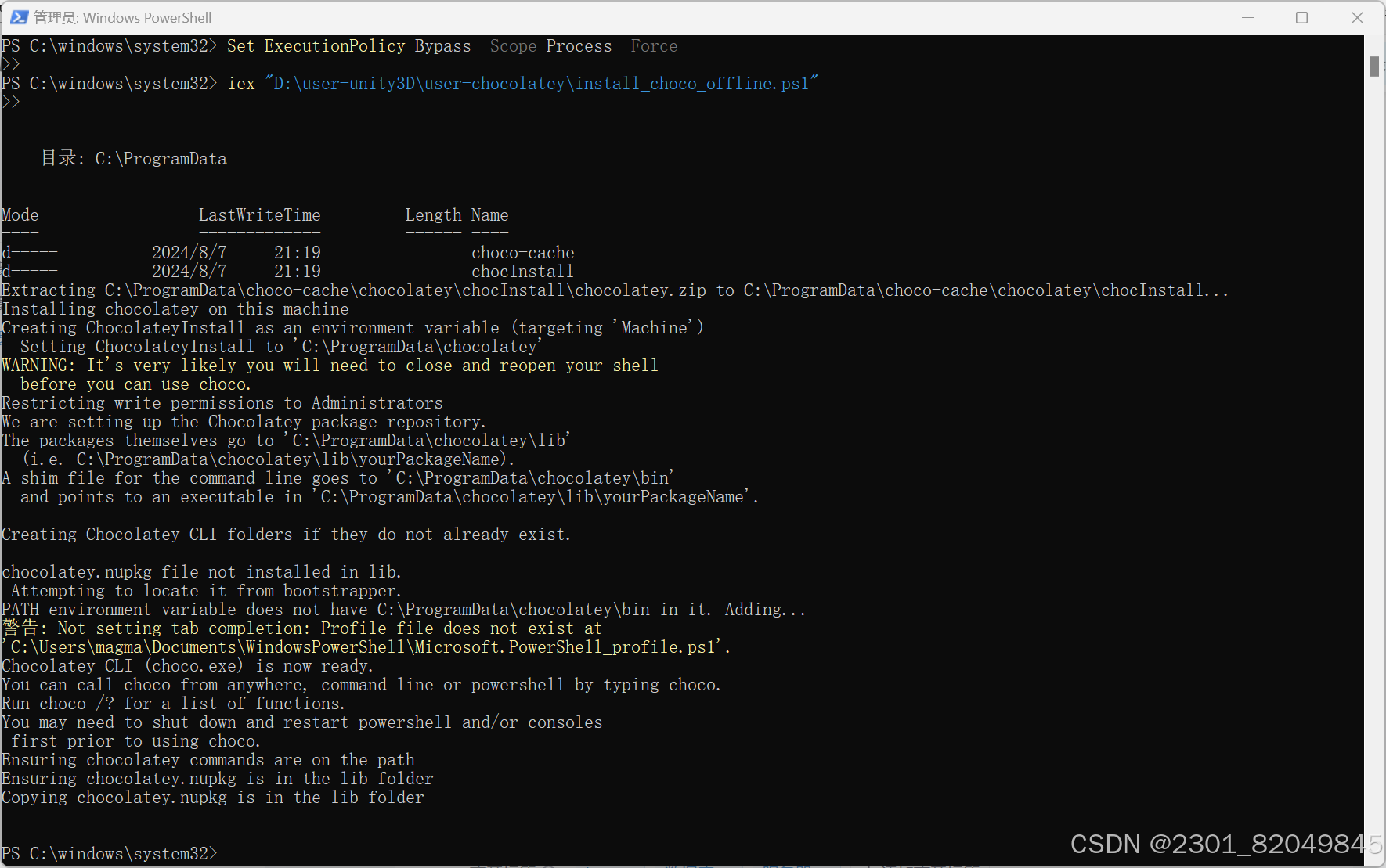
这样就安装完毕啦!
可以通过如下命令检查是否安装成功:
choco -v 输出版本号:
也可以通过如下命令输出安装路径:
[System.Environment]::GetEnvironmentVariable('ChocolateyInstall', [System.EnvironmentVariableTarget]::Machine)输出路径则成功:
可能出现的问题:
尽管你已经以管理员身份运行PowerShell,执行策略仍然可能阻止脚本的运行。
临时设置执行策略:
- 在管理员模式下的PowerShell窗口中,输入以下命令来临时绕过执行策略,然后再执行上面的iex命令:
-
Set-ExecutionPolicy Bypass -Scope Process -Force
相关内容
热门资讯
小米MiMo Token Pl...
IT之家 6 月 2 日消息,小米今日正式公布了 MiMo Token Plan 老用户专属“回归礼...
2026年6月防销售飞单AI工...
销售飞单、私单、客资外流,是各大销售型企业长期面临的核心难题。普通通讯设备缺乏管控能力,改装机型存在...
苹果智能眼镜据报道推迟至202...
如果你一直期待着拥有一副苹果智能眼镜,恐怕需要比预期等待更长的时间了。 据彭博社记者马克·古尔曼透露...
Anthropic刚递表IPO...
Anthropic已经秘密向美国证券交易委员会(SEC)递交了 S-1注册声明草稿。这意味着一旦SE...
智博会启新章 中国电信深耕AI...
(记者 林碧涓)2026世界智能产业博览会于5月28日至31日在天津举办。本届博览会由天津重庆两地政...