

链表List
创始人
2024-11-06 13:37:11
简介
STL中的List与顺序表vector类似,同样是一种序列式容器,其原型是带头节点的双向循环链表。
List的使用
list中的接口比较多,此处类似,只需要掌握如何正确的使用,然后再去深入研究背后的原理,已达到可扩展的能力。以下为list中一些常见的重要接口。
List的构造
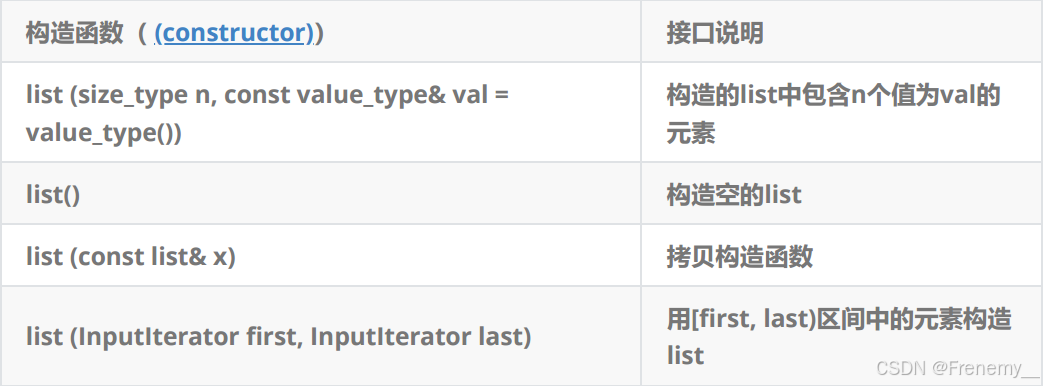
构造的使用
list l1; 无参构造 list l2(5, 10);//放5个值为10的数据 list l3(l2.begin(), l2.end()); 迭代器构造 list l4(l3); 拷贝构造 构造的实现
无参构造
template struct list_node { T _data; list_node* _next; list_node* _prev; list_node(const T& data = T()) :_data(data) , _next(nullptr) , _prev(nullptr) {} }; template typedef list_node Node; typedef list_iterator Self; Node* _node; list() { _head = new Node; _head->_next = _head; _head->_prev = _head; _size = 0; } private: Node* _head; size_t _size; 迭代器iterator
概念
此处我们可以将iterator理解为指针,指向list中的某一个节点。
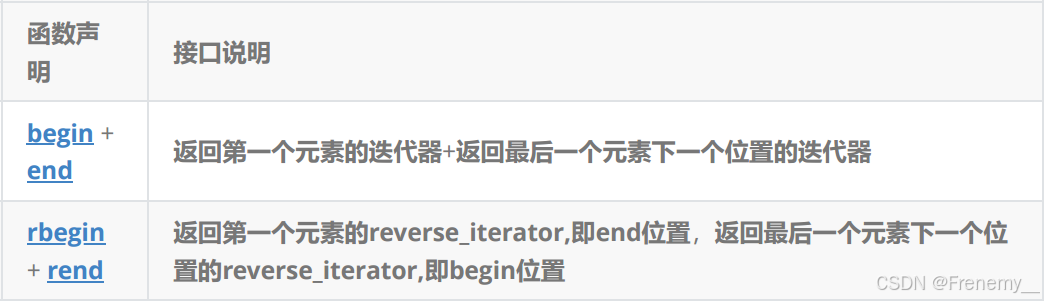

以图示为例,list头节点的begin()迭代器扮演了指针的角色指向了下一个节点,依次往后。
注意
1. begin与end为正向迭代器,对迭代器执行++操作,迭代器向后移动
2. rbegin(end)与rend(begin)为反向迭代器,对迭代器执行++操作,迭代器向前移动
iterator的使用
由于链表节点之间不连续的性质,我们对其进行遍历时也必须使用迭代器或范围for.
我们以链表的遍历打印(顺序和倒序)为例,代码如下:
正序 int array[] = { 1, 2, 3, 4, 5, 6, 7, 8, 9, 0 }; list l(array, array + sizeof(array) / sizeof(array[0])); // 使用正向迭代器正向list中的元素 // list::iterator it = l.begin(); // C++98中语法 auto it = l.begin(); // C++11之后推荐写法 while (it != l.end()) { cout << *it << " "; ++it; } cout << endl; 倒序 // 使用反向迭代器逆向打印list中的元素 // list::reverse_iterator rit = l.rbegin(); auto rit = l.rbegin();//此句是现代写法,C++11后才支持 while (rit != l.rend()) { cout << *rit << " "; ++rit; } cout << endl; iterator的实现
begin() 与 end()
iterator begin() { /* iterator it(_head->_next); return it;*/ //return iterator(_head->_next); return _head->_next; 最直接的写法 } iterator end() { return _head; }list接口
list capacity(容量)
目录

empty判空
bool empty() const { return _size == 0; }size
size_t size() const { return _size; }list element access(成员访问)
目录

front
void pop_front() { erase(begin()); }back
void pop_back() { erase(--end()); }list modifiers(链表调整)
目录
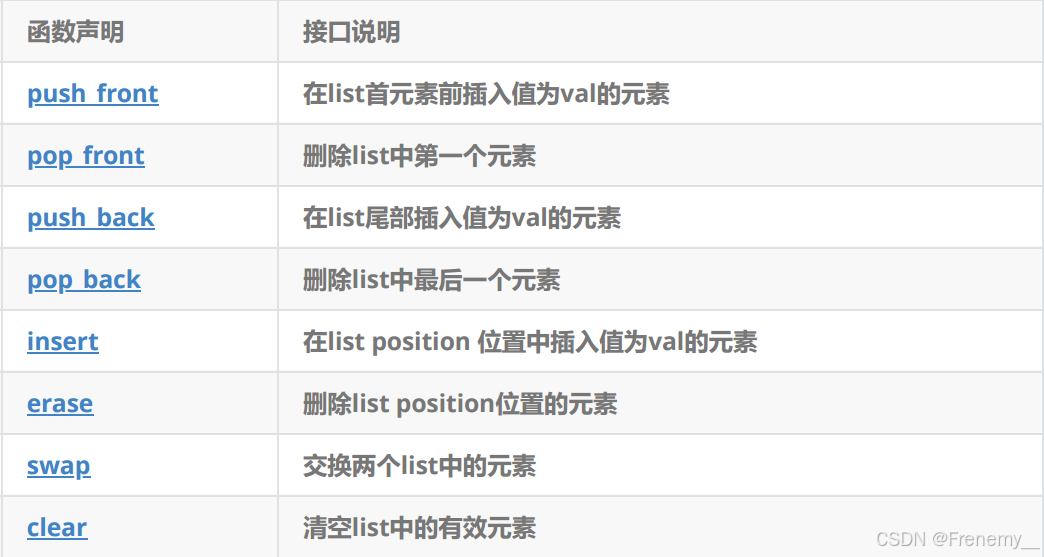
insert
void insert(iterator pos, const T& x) { Node* cur = pos._node; Node* prev = cur->_prev; Node* newnode = new Node(x); // prev newnode cur newnode->_next = cur; cur->_prev = newnode; newnode->_prev = prev; prev->_next = newnode; ++_size; }接下来的插入复用insert代码即可。
push_front
void push_front(const T& x) { insert(begin(), x); }push_back
void push_back(const T& x) { insert(end(), x); }erase
void erase(iterator pos) { assert(pos != end()); Node* prev = pos._node->_prev; Node* next = pos._node->_next; prev->_next = next; next->_prev = prev; delete pos._node; --_size; }同理,头删尾删代码复用删除代码即可。
pop_front
void pop_front() { erase(begin()); }pop_back
void pop_back() { erase(--end()); }clear
void clear() { auto it = begin(); while (it != end()) { it = erase(it); } }swap
void swap(list& lt) { std::swap(_head, lt._head); std::swap(_size, lt._size); } 使用
插入和删除
void TestList3() { int array[] = { 1, 2, 3 }; list L(array, array + sizeof(array) / sizeof(array[0])); // 在list的尾部插入4,头部插入0 L.push_back(4); L.push_front(0); PrintList(L); // 删除list尾部节点和头部节点 L.pop_back(); L.pop_front(); PrintList(L); } clear
~list() { clear(); delete _head; _head = nullptr; }swap
list& operator=(list lt) { swap(lt); return *this; } list迭代器失效
与顺序表类似,list的迭代器失效也是由于iterator指向的节点发生了变化,可能不是我们想要的节点。迭代器失效即迭代器所指向的节点的无效,即该节点被删除了。因为list的底层结构为带头结点的双向循环链表,因此在list中进行插入时是不会导致list的迭代器失效的,只有在删除时才会失效,并且失效的只是指向被删除节点的迭代器,其他迭代器不会受到影响。
在这里,我们仍然举个例子:
void TestListIterator1() { int array[] = { 1, 2, 3, 4, 5, 6, 7, 8, 9, 0 }; list l(array, array + sizeof(array) / sizeof(array[0])); auto it = l.begin(); while (it != l.end()) { // erase()函数执行后,it所指向的节点已被删除,因此it无效,在下一次使用it时,必须先给 //其赋值 l.erase(it); ++it; } } 同样地,我们只要将l.erase(it)前加上“it = ”即可:
void TestListIterator1() { int array[] = { 1, 2, 3, 4, 5, 6, 7, 8, 9, 0 }; list l(array, array + sizeof(array) / sizeof(array[0])); auto it = l.begin(); while (it != l.end()) { // erase()函数执行后,it所指向的节点已被删除,因此it无效,在下一次使用it时,必须先给 //其赋值 it = l.erase(it); ++it; } } list与vector的对比
vector与list都是STL中非常重要的序列式容器,由于两个容器的底层结构不同,导致其特性以及应用场景不同,其主要不同如下:

List实现总代码
#pragma once #include #include #include using namespace std; namespace Frenemy { template struct list_node { T _data; list_node* _next; list_node* _prev; list_node(const T& data = T()) :_data(data) , _next(nullptr) , _prev(nullptr) {} }; template struct list_iterator { typedef list_node Node; typedef list_iterator Self; Node* _node; list_iterator(Node* node) :_node(node) {} Ref operator*() { return _node->_data; } Ptr operator->() { return &_node->_data; } Self& operator++() { _node = _node->_next; return *this; } Self& operator--() { _node = _node->_prev; return *this; } Self operator++(int) { Self tmp(*this); _node = _node->_next; return tmp; } Self& operator--(int) { Self tmp(*this); _node = _node->_prev; return tmp; } bool operator!=(const Self& s) const { return _node != s._node; } bool operator==(const Self& s) const { return _node == s._node; } }; template class list { typedef list_node Node; public: /*typedef list_iterator iterator; typedef list_const_iterator const_iterator;*/ typedef list_iterator iterator; typedef list_iterator const_iterator; iterator begin() { /* iterator it(_head->_next); return it;*/ //return iterator(_head->_next); return _head->_next; } iterator end() { return _head; } const_iterator begin() const { return _head->_next; } const_iterator end() const { return _head; } void empty_init() { _head = new Node; _head->_next = _head; _head->_prev = _head; _size = 0; } list() { empty_init(); } list(initializer_list il) { empty_init(); for (auto& e : il) { push_back(e); } } // lt2(lt1) list(const list& lt) { empty_init(); for (auto& e : lt) { push_back(e); } } // lt1 = lt3 list& operator=(list lt) { swap(lt); return *this; } ~list() { clear(); delete _head; _head = nullptr; } void clear() { auto it = begin(); while (it != end()) { it = erase(it); } } // 16:18继续 void swap(list& lt) { std::swap(_head, lt._head); std::swap(_size, lt._size); } void push_back(const T& x) { insert(end(), x); } void push_front(const T& x) { insert(begin(), x); } iterator insert(iterator pos, const T& x) { Node* cur = pos._node; Node* prev = cur->_prev; Node* newnode = new Node(x); // prev newnode cur newnode->_next = cur; cur->_prev = newnode; newnode->_prev = prev; prev->_next = newnode; ++_size; return newnode; } void pop_back() { erase(--end()); } void pop_front() { erase(begin()); } iterator erase(iterator pos) { assert(pos != end()); Node* prev = pos._node->_prev; Node* next = pos._node->_next; prev->_next = next; next->_prev = prev; delete pos._node; --_size; return next; } size_t size() const { return _size; } bool empty() const { return _size == 0; } private: Node* _head; size_t _size; }; struct AA { int _a1 = 1; int _a2 = 1; }; // 按需实例化 // T* const ptr1 // const T* ptr2 template void print_container(const Container& con) { // const iterator -> 迭代器本身不能修改 // const_iterator -> 指向内容不能修改,不能进行权限放大,只能进行权限缩小 typename Container::const_iterator it = con.begin(); //auto it = con.begin(); while (it != con.end()) { //*it += 10; cout << *it << " "; ++it; } cout << endl; for (auto e : con) { cout << e << " "; } cout << endl; } void test_list1() { list lt; lt.push_back(1); lt.push_back(2); lt.push_back(3); lt.push_back(4); list::iterator it = lt.begin(); while (it != lt.end()) { *it += 10; cout << *it << " "; ++it; } cout << endl; for (auto e : lt) { cout << e << " "; } cout << endl; print_container(lt); list lta; lta.push_back(AA()); lta.push_back(AA()); lta.push_back(AA()); lta.push_back(AA()); list::iterator ita = lta.begin(); while (ita != lta.end()) { //cout << (*ita)._a1 << ":" << (*ita)._a2 << endl; // 特殊处理,本来应该是两个->才合理,为了可读性,省略了一个-> cout << ita->_a1 << ":" << ita->_a2 << endl; cout << ita.operator->()->_a1 << ":" << ita.operator->()->_a2 << endl; ++ita; } cout << endl; } void test_list2() { list lt1; lt1.push_back(1); lt1.push_back(2); lt1.push_back(3); lt1.push_back(4); list lt2(lt1); print_container(lt1); print_container(lt2); list lt3; lt3.push_back(10); lt3.push_back(20); lt3.push_back(30); lt3.push_back(40); lt1 = lt3; print_container(lt1); print_container(lt3); } void func(const list& lt) { print_container(lt); } void test_list3() { // 直接构造 list lt0({ 1,2,3,4,5,6 }); // 隐式类型转换 list lt1 = { 1,2,3,4,5,6,7,8 }; const list& lt3 = { 1,2,3,4,5,6,7,8 }; func(lt0); func({ 1,2,3,4,5,6 }); print_container(lt1); } }
相关内容
热门资讯
裸辞做“一人公司”,我后悔了
去年这个时候,一位以色列程序员正在东南亚旅行。他顺手把一个在脑子里转了很久的想法做成了产品,一个让任...
南京建成国内首个Pre-6G试...
4月21日,2026全球6G技术与产业生态大会在南京开幕。全息互动技术展台前,一名远在北京的工作人员...
超梵求职受邀参加“2025抖音...
超梵求职受邀参加“2025抖音巨量引擎成人教育行业生态大会”,探讨分享优质内容传播,服务万千学员。 ...
摩托罗拉Razr 2026(R...
IT之家 4 月 22 日消息,摩托罗拉宣布新一代 Razr 折叠手机将于 4 月 29 日在美国发...
库克卸任,特纳斯领航:苹果新纪...
苹果首席执行官蒂姆·库克将卸任,硬件工程主管约翰·特纳斯将接任,苹果公司今天宣布此事。 库克将在夏季...